 Please share your realisations with other devotees from around the world...simply send me an introduction email and I will be happy to make you a member:
rasa108@gmail.com
ys
Rasa Rasika dasa
Please share your realisations with other devotees from around the world...simply send me an introduction email and I will be happy to make you a member:


Humility is often referred to as one of the most significant attribute of a great leader. In his book good to great, Jim Collins speaks about “humility “ along with “professional will” as key attributes a person must possess to be a level 5 leader. A great leader to be precise.
With the above backdrop lets see why we seem to like humble people or rather want people with humility to be our leaders. Then humility is a matter of perception. Humility is often confused to being quiet, silent, politically correct etc. Humility in my opinion has different behavior expectations in different situations. Humility is what it takes to stand up and speak, at the same time, humility is also what it takes to sit down and listen.
Humble people are fiercely competitive; yet respect their opponents for what they are and what they have. They differentiate lucidly between sport and life. They know how to separate issue from personality. They consistently learn and perform the art of balancing. They are principle centered. All of us are subjected to different challenges in different phases of life.
“The quantum of trial” varies from time to time. The quality of humility helps leader prevail over the trial each time and emerge stronger than ever before.
Today humility is a frequently used terminology in public life, especially in politics and very commonly used in corporate world as well. Most of the time it is referred as an antonym to “arrogance”. It’s a label to judge people”. Mostly we find “humility” associated with people who are quiet, introverted and harmless. As perceived. It’s not necessarily true. Humility today has become a kind of mask, which people use for manipulation or create a space for manipulation. In all walks of life.
Humility by truth is an outcome of constant trial, which an individual undergoes on an ongoing basis. Each time, the response he or she makes based on convictions and principles without being coerced by any external or internal stimuli whatsoever or by virtue of any emotion including fear. It’s a display of consistent integrity wherein one walks the talk.
Pride is opposite to humility. Humility is when you know you have the power, yet you don’t invoke it and show character to go an extra mile to protect interest of all involved. Particularly the weak.
Lets look at some interesting paradigm. Today, when a politician wants to go on fast, he musters large number of people using all his machinery, power etc. Years back, when Gandhi wanted to strike, He said “I am going on fast” and the whole nation followed him. Humble people lead by example. They have grace and charisma that reflects their character. They carry themselves well. Similarly in sports, when Sachin drives the ball or when Federer punches a strong forearm stroke, they display grace alongside power and perfection. Even opponents admire and adore them. That’s humility in action.
Mother Theresa remains as an epitome of humility through her service to mankind. Jesus through his teachings of love and forgiveness had a universal acceptance of his humble leadership even today. When a coward terrorist act burnt her family alive in north India, Mrs Staines displayed remarkable humility in forgiving the people who were involved and continued with the mission, which her husband had started. Humility is all about principles and hence stands the test of time.
Humility is to be unfazed by personal tragedies and stay firm on course for the larger purpose one gets chosen for. The choice and purpose depends on each individual and their evolution.
To display humility is an opportunity one gets all the time in different role we play. Be it a parent, child, citizen, leader, steward, friend, relative, employee and soon. We get our chances to act. With all equity and fairness. Then it’s a matter of choice based on principles and values we have imbibed within us that determines our action for every situation we encounter. It’s the choice we make with courage, irrespective of the situation, people or pressure we are faced with earns us the characteristics of being a humble person. Its is not a default tag one gets. One has to keep earning it and work for it. All the time.
Humble people don’t make excuses. They build bridges for themselves and for people around them. They stand out.
Humility hence is all about strength. Weak people cannot be humble.Humility hence is sign of strength NOT weakness…
To be aware of the evolution and change in you and around you would be the key …. to begin with.


 After the marriage of Princess Klementyna and Prince James, they had a son. Naming him Charles Edward Louis John Casimir Silvester Severino Maria Stuart. He is destined to lead the "45" Jacobite rising as "Bonnie Prince Charlie". His birthday is today 31 December in the year 1720.
 Hare Krsna everyone. Today I just want to thank you all for the nice association I had from you all during this year of 2008. If I had to state here all my experiences in this blog, I could say it brought me much more realisations than I had in my all 16 years of Krsna consciousness. First because I could share with you all my steps and experiences with chanting, then I got purified by listening to lectures, retreats, classes and reading all in order to give you the best from senior vaisnava's realisations and teachings on japa.
 Happy New Year, everyone. I hope you and your families have a wonderful happy, safe and successful 2009.
I completely forgot about the resolution I made last year (December 2, 2007 to be exact - why wait for the New Year’s rush?) to write the magnum opus. It must have been simmering on the back burner as the thousand and one priorities got in the way because as the year wore on Jack and I returned to working through details. We even submitted a proposal a couple of weeks ago. Now, with two days to go before year’s end, it is almost complete.
Did it happen because of the resolution? Or despite it?
Human nature being what it is, we are so often our own worst enemy. We refuse to listen to reason, choking off the wisdom of our own inner voice. We take our hard-won power and toss it away like trash. And we fight our most positive impulses with a hodge-podge of anxiety, conflict and confusion.
I’d like to think I did it because I promised you I would and I like to keep my word. So I’ll give you this one for 2009. Words. I’ll be back with a lot more of them.
 Sometimes the best art is fashioned from the simplest of elements. On its surface, White Dog comes off like a low-budget contractual obligation at the end of a career, or a career-in-transition vehicle for a rising star (Kristy McNichol) gone miserably wrong. However, and especially after its first half hour, White Dog stands as Samuel Fuller's most profound work. Unappreciated even up unto its director's passing, the long overdue DVD release of White Dog should bring more allure and discussion about Fuller's ever evolving legacy.
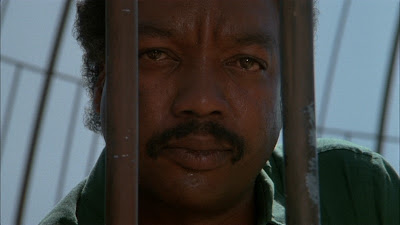 Late one night in the Hollywood Hills, an aspiring actress, Julie (McNichol), hits a dog with her car. She takes the all-white German Shepard to the vet then keeps watch over him while awaiting a response from her FOUND DOG fliers. After saving her from a rapist, Julie and the dog bond. However, Julie soon discovers that her new companion is an attack dog trained to maul black people. She then takes the dog to a animal shelter where a man named Keys (Paul Winfield) vows to break the mutt from its hateful ways.
The scenes between Keys and the German Shepard make up the heart of White Dog. As Keys' racial counterpart, it was an ingenious move by Fuller to bottle the learned behaviors of hatred and bigotry inside of an animal instead of a human. An actor would be too aware, handling face-to-face scenes of unleashed and uncaged racial confrontation with a heavy, knowing cloud over their head. But a dog acts on instinct; its performance doesn't pay notice to the camera.
Images of Keys lifting his shirt, exposing his black skin just inches from the caged eyes of a snarling white-coated beast are equal to the purest visual cinema we get from silent film. In fact, sequences between Keys and the dog retain their power even with the sound turned down. Keys' resilience is admirable, almost saintly. When the dog escapes and brutally kills a man inside a church (looking up at a stained-glass image of St. Francis as if to scoff at it), Keys refuses to put him down, even against the wishes of Julie. Allusions to Keys as a MLK-type figure would not be ridiculous.
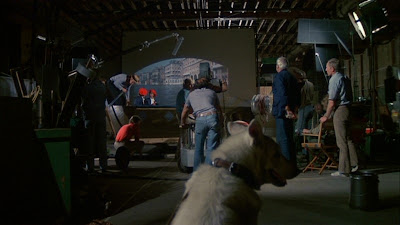
Like any great film, multiple viewings and late-night reflection can open up doorways and interpretations that didn't initially stand out. One of my pet theories about White Dog is that, on a sub-textual level, the dog symbolizes Hollywood producers/"the industry", a guard keeping red-fanged watch on frustrated visionaries like Fuller.
In one specific scene (pictured above) Julie's dog tags along on a film shoot. Before the set is crashed in a fit of stark violence by the dog onto a black actress, Fuller gives us a peek of this "movie inside a movie" being filmed. Shot against cheap rear projection and flimsy props, two young women tour the streets of Paris. One can't help but see this as Fuller's jabbing acknowledgement that France became somewhat of a critical safety zone for him in his later years. And there is further, possible back-scratching reference to the New Wave's well-known validation of Fuller when Nichols takes a copy of Hitchcock/Truffaut with her to the hospital as a get well gift for the attacked actress.
On its broadest level, White Dog is about ingrained bigotry of all kinds. Learned or not, that type of behavior is inexcusable and Fuller treats it as such. However, he also appreciates the complication (see the black & white type on a gray background during the title sequence) and steps away from any quick condemnation. Why else do you think he chose a dog, perhaps the most sympathetic creature on Earth, to carry the weight of the most despicable actions of humankind?
[NOTE: Movie stills taken from DVDBeaver]
 This weekend unbeknown to me the History Channel played a series of programs on the French Revolution. Now this series had played before but I had purposely neglected to watch it because the History Channel has be come a mouthpiece of those "progressive" elements in American society. My wife Suzanne however, did surf through the TV and found the series and watched it. I caught only the last part of the last episode, the one which contained the excesses of the Vendée, the de-Christianization under Hebert, the death of Robespierre and the Rise of the Ogre.
 This weekend I went to see the much advertised Valkyre, starring Tom Cruise. I had hoped for better. Being a Catholic and familiar with the story of Claus Schenk Graf von Stauffenberg I saw none of the torment that he felt in making his decision to commit tyrannicide. As many officers Von Stauffenburg originally was a supporter of the Nazis and Hitler in particular. As the war progressed and he realized he was a part of a giant killing machine he grew disenchanted.
 The baby's father, Adolfo Jorge Huamani, 24, is a carpenter. Religious Peruvians compared him to Joseph the Carpenter in the Bible.


 博文
所有评论
博文
所有评论


