 I'm not the biggest David Fincher fan, but The Curious Case of Benjamin Button feels like the obvious ugly duckling among the director's brief, but powerful, body of work. From Alien 3 to Zodiac, Fincher's revealed an obsession with the procedures humans follow in order to either fit in, protect, or solve questions. Visually, Fincher's always kept one hand in the seedy, and another in the technically adept, a combination that I can admire from far away but that's left me cold in widescreen. The exception was Panic Room, a film worthy for not only pulling off Jared Leto in corn rows, but in giving a fresh face to the siege movie, turning Jodie Foster into a timely post-9/11 paranoid American and strong single mother.
Maybe this has been kicked around on internet movie sites already and I've just missed it, but, after watching Benjamin Button, I'm curious about something myself. Did David Fincher just lay down for a contractual obligation, OR, was this a pet project he'd been wanting to tackle for some time? Because you coulda shoved cotton in my ears for a year, taken my virgin senses to a screening of Benjamin Button, then told me it was directed by Ron Howard and I would've believed you. But I knew it was Fincher, and from those early trailers with the creepy looking Brad Pitt midget that carried old skin and a sex offender grin, there was a convincing Fincher-esque quality to it.
Then there's the hook of the story itself: a male infant that is born physically old and ages backwards. This isn't as lame as it sounds. There's a buzz to be gotten from these Big/Vice Versa type of scenarios where the inner being of a child is shifted into the body of an adult. Benjamin Button just pushes this to the extreme. A seven year old in a eighty year old body... a seventeen year-old in a seventy year old body... a ninety year-old in a two year-old body.
This could make for some interesting insights. How much is our perception of old age built on the idea of youthful beauty? As Benjamin (Pitt) replies to an offer of sympathy about being burdened with an elderly body, "Being old isn't bad". But no, Fincher simply slips in some convenient and easy yoinks! jokes about penises, incontinence, and an old-man who can go all night without the assistance of Viagra.
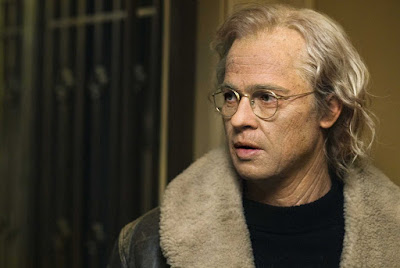 It's not that Benjamin Button is ultimately so terrible, because it's not. Brad Pitt is markedly cute throughout, Taraji P. Henson is huggably loveable, and while Benjamin's adventures aren' t as guilty pleasurable as Forrest's, they do fine. But when the best compliment you can give to a movie is to say that it's "harmless" (aka a passable treadmill movie) then you're just tolerating mediocrity again, and the last thing our movie culture needs now is more mediocrity.
But truly, you really gotta start wondering what a year like this could mean for an institution like the Oscars. With media moving online, wider catalogs of movies becoming more accessible, and Best Picture honors seeming more like a momentum-killing kiss of death towards a film's legacy than an "ageing classic" badge of honor (know anybody who really admires Chicago, A Beautiful Mind, Crash, Shakespere In Love, or American Beauty as "great" anymore?????) maybe this traditional year-end punctuation ceremony is nearing its death. Uh, yeah, sorry... forget that.... because as Woody Allen alludes to in Annie Hall, the ego-driven elite will never forgo an opportunity to get lit, hang out in a room together, and tell each other how awesome they all are.
It makes me wonder how aware they are that the only reason we watch anymore is to get together with friends and play some really fun, self-made, Oscar party games. I'm proud of the way Americans have adapted in order to make something useful out of the annual five hour narcissism exhibition. We gave up on the Academy Awards entertaining us, so we figured out a way to do it ourselves... and they're just the pawns.


 博文
博文


没有评论:
发表评论