 Not three minutes into Gran Torino and Walt Kowalski's (Clint Eastwood) squinty-eyed, mumbling growl ("mmmgrrrrr") is already walking itself towards the door of infamous movie verbalizations, grabbing a chair at the table of Al Pacino's "whoo-wa!" in Scent of a Woman, and Billy Bob Thorton's "mmm-hmm" in Sling Blade. Luckily, that cartoonish mannerism fades away, but because Eastwood is not a subtle director (remember that glow in the dark cross that dangled from the priest's neck at the beginning of Mystic River?... oy) he continues to beat the audience over the head with the many flaws/traits of Walt: racial slurs, "these kids today" jibes, tobacco spitting, rifle toting. It's enough already after thirty minutes.
But then Gran Torino gets good. Walt's relationship with his Hmong neighbors, and his place in the transformed Hmong community of old Detroit, opens up honest moments of modern cross-generational racial anxiety. Instead of the Hmong brother and sister joining together to help Walt grow a golden heart of rainbow tolerance, Eastwood shows the emotional depth and complexity that can exist under the skin of someone who wears a face of bigotry. Even as tempers cool and the Lor family accepts Walt into their home, the old man doesn't refrain from his stereotype-driven humor. While grilling, Walt asks, "How do you take your dog?". Without missing a beat, Sue fires back, "I've told you, we eat cats!".
This true-to-life method of breaking down preconceived notions and confronting cultural differences (Richard Pryor, anyone?) flies in the face of the regressive divide-and-conquer militancy of Milk and the quick-to-incriminate post-Prop 8 judgmentalism that came along with it. What Gus Van Sant propagandizes in Milk is a one-strike and throw away the key method of dealing with surface bigotry or even philosophical differences.
 Walt is prejudiced, but he's not a bad man. The Hmong grandmother may be prejudiced, but she's not a bad woman. These are old school people refusing to roll along with the new world's rules. Their leisure time is spent sitting on porches, not shopping, watching DVDs, or playing video games. Their spitting, exclaiming, and the racial epithets of Walt's, are defensive moves, actions used out of self-preservation more than pure hatred. Take a step back, and Walt is more accurately defined as a bitter man than a racist, equally showing contempt for everyone & everything around him (his grandchildren, his priest, retirement homes, horoscopes)... everything but his dog. This is a contempt he acknowledges, and isn't proud of, when he tells Sue, "I'm not a good man."
Eastwood's direction is decidedly simply throughout. His camera moves delicately between, and inside, the adjacent houses. Check the generational contrast Eastwood creates between the upstairs and downstairs sections of the Lor's house. Sue (Ahney Lor) invites Walt over for a friend & family barbecue. Upstairs are the adults, a representation of traditional Hmong culture existing in a new homeland. Sue instructs Walt of the customs, that "it's considered rude to look a Hmong person in the eye", and that touching a Hmong on the top of the head is forbidden because "that's where the soul lives". But just a floor below, the younger, American born generation of Hmong teens carry-on like regular western high school kids. Music, flirting, gossiping. None of the rules Sue laid out for Walt upstairs apply anymore.
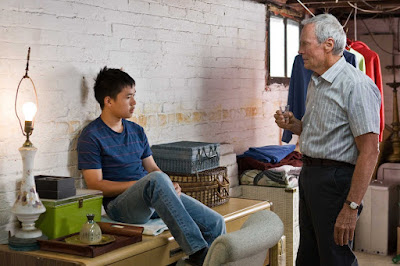 Yet, despite Gran Torino's achievements - and like many Clint Eastwood movies - there are errors in artistic judgment that hold the film back from greatness. For example, Eastwood should have practiced restraint on the slur-slinging after he clearly establishes the mentality of Walt. The scene where Sue takes Walt down to the basement to meet her friends could have been executed visually without Walt calling the kids "slopes" or "zipperheads", or calling Thao a "pussycake". At this point, the insults start to become comical, and they begin to lose a significance that applied earlier in the film.
Visually, why didn't Eastwood carry this basement scene by just simply shooting himself among the teenagers that are observing him and he them? There is a brief moment, prior, where Walt's cautiousness is physically expressed when we see him nervously leaning against a wobbly washing machine. That splash holds a visual tone that Eastwood should have run with for the entire sequence, yet, strangely, he abandons it. Unfortunately, he does the same in other sequences as well.
Still, it does feels nice to finally have an award-season film that I feel like rooting for.


 博文
博文


没有评论:
发表评论